
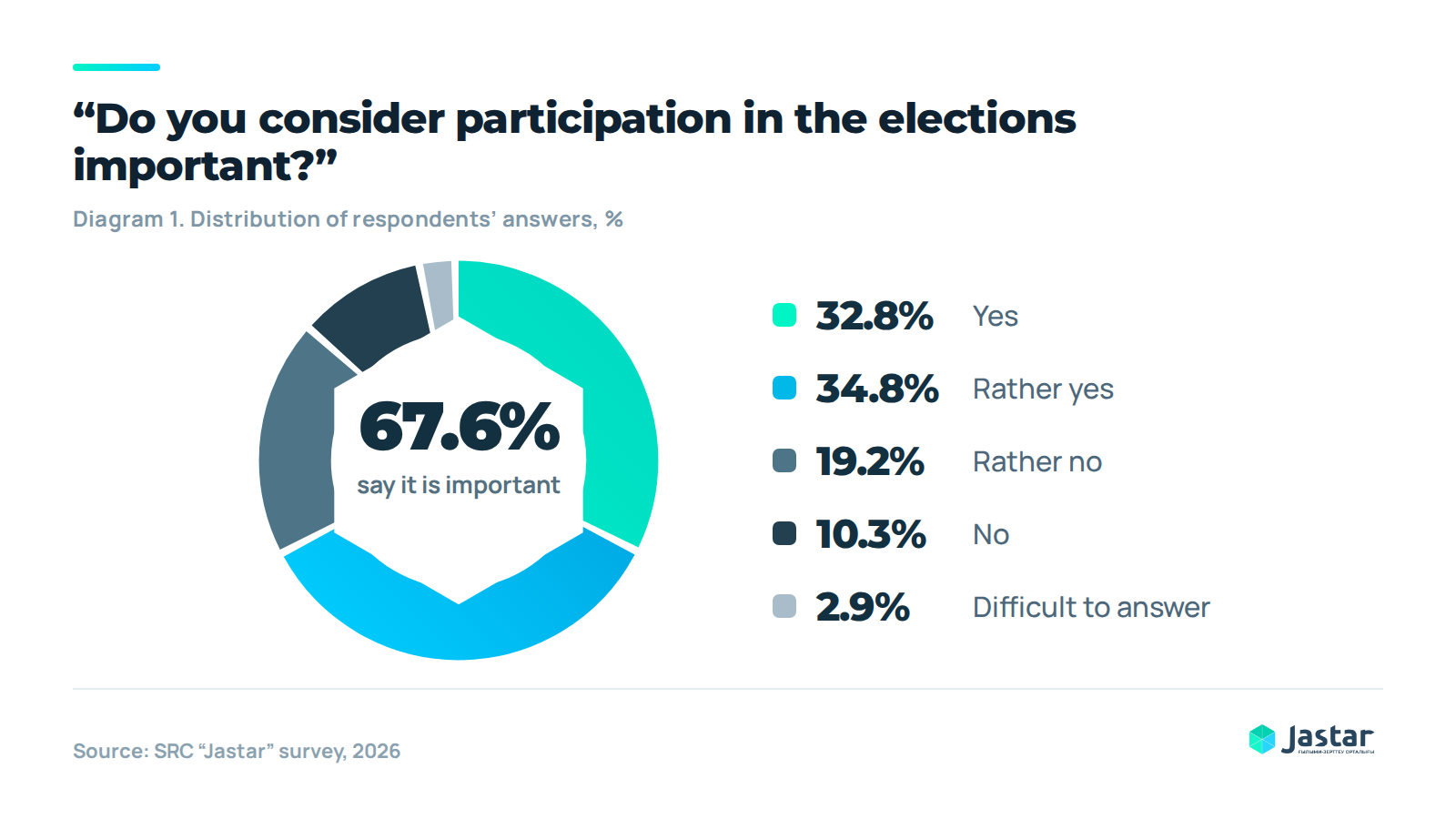
Two-thirds of young people in Kazakhstan – or, more precisely, 67.6% – consider participating in elections to be important. This is not merely abstract loyalty, but a sign that political reforms in the country over recent years have created a genuine desire among young people to participate in the governance of the state.
Since July 1 of this year, a new Constitution has been in force in Kazakhstan, which has enshrined the expansion of citizens’ participation in public administration and the development of public dialogue. For the first time in 30 years, the institution of vice president has been restored. Elections of deputies of the Kurultai of the Republic of Kazakhstan are being held. Each of these steps is not a one-time measure, but part of a consistent state policy to involve citizens, primarily young people, in decision-making.
Diagram 1. Distribution of respondents’ answers to the question
«Do you consider participation in the elections important», %.
Interest is growing faster than literacy, and this is a task, not a problem
According to the SRC «Youth» for 2026, 43.8% of young people in Kazakhstan are well aware of the procedure for holding elections and their voting rights. This figure is lower than the level of interest in elections, and this is a natural stage, because interest in politics almost always outstrips the practical skills of participation in it. The state is already responding to this gap by expanding educational programs and making election procedures more understandable and transparent.
It is important that young people perceive elections not just as a formal procedure, but as one of the real mechanisms of influence on socio-political processes, and this is a direct consequence of the fact that institutions have become more open.
Young people are not only voters, but also candidates
The observed dynamics suggests that the very understanding of civic participation is gradually changing in the youth environment. If earlier social and political activity was mainly associated with interest in current events, today the demand for the use of institutional mechanisms for participation in making socially significant decisions is increasing.
One of these opportunities is the upcoming elections of deputies of the Kurultai of the Republic of Kazakhstan. An analysis of the party lists registered by the CEC shows that young people are increasingly integrated into socio-political processes not only as an electorate, but also as direct participants in the electoral process. In total, the parties have nominated 545 candidates, of whom 67 (or 12.3%) are young people under the age of 35.
The largest youth representation was formed by the Adilet party, which nominated 26 candidates out of 186 (13.9%), including 15 participants of the Presidential Youth Personnel Reserve. The Ak Zhol DPK list includes 10 young candidates out of 63 (15.9%), the People’s Party of Kazakhstan – 9 out of 72 (12.5%), the Respublica and Auyl parties – 7 candidates each (9.3% and 10.1% respectively), the OSDP – 6 out of 33 (18.2%), and the Baitaq Green Party – 4 out of 47 (8.5%).
The qualitative dimension of the identified trend proved no less telling. Young people on the lists are represented by the heads of the youth wings of almost all parties, current deputies of the VIII convocation of the Mazhilis, entrepreneurs, scientists and public sector specialists.
From news tracking to party membership
Trends in recent years show a steady increase in engagement. In 2023, 52.5% of young people in Kazakhstan were interested in political news, with 24.1% of them following it almost daily. By 2024-2025, that attention had begun to translate into hands-on engagement. The share of young people periodically participating in party activities increased from 3.2% to 6.9%, and the share of those who are ready to join the party increased from 15.8% to 16.1%. The observed changes reflected in the research of the SRC «Youth» record a gradual transition from a paternalistic model of interaction to a partner model, where the state and youth act together.
What’s next
In general, the transformation of civic participation of young people in Kazakhstan is systemic. Reforms are ongoing and, as they are completed, a full assessment of their effect can be made. But the main thing is already visible. The state consistently creates institutional opportunities for young people, and young people are increasingly using them, going from interest in elections to candidate lists and party membership.
Alyona Dmitriyeva, Head of the Analysis and Communications Department, SRC “Youth”
Zhadra Ayukhan, Expert of the Analysis and Communications Department, SRC “Youth”